SEO Tips for How to Build an Optimized Landing Page
How to Build an Optimized Landing Page
A Landing Page is one of the most powerful tools in digital marketing. It’s not just a place where users arrive; it’s the gateway to conversions, brand authority, and better search engine visibility. Unlike random web pages, landing pages are designed with a purpose, whether to capture leads, sell a product, or drive subscriptions.
But here’s the question: how do you make your landing page truly optimized for SEO? Many businesses fall into the trap of treating landing pages as simple advertising portals without considering search engines. The truth is, a properly structured landing page can rank in search results, attract organic visitors, and build long-term value.
In this article, we’ll explore the best SEO tips for creating an optimized landing page, clarify the common confusion between landing pages and squeeze pages, and highlight strategies that make your page visible, fast, and user-friendly.

Landing Page vs Squeeze Page: Understanding the Difference
What is a Landing Page?
A dedicated page is created to capture traffic from a campaign, search engine, or direct visit. It can be a homepage or a subdomain page, designed to rank for multiple keywords while providing meaningful content.
Why Squeeze Pages Don’t Work for SEO
A Squeeze Page, on the other hand, focuses only on quick data collection, often through paid ads. These pages are not SEO-friendly because:
They lack valuable content.
They rely on paid traffic instead of organic search.
They risk being flagged as low-quality by search engines.
Mixing up the two is a big mistake. Optimized pages can grow organically; squeeze pages cannot.
Core SEO Tips for an Optimized Page
Choose Between Homepage or Subdomain
Goodbye to the old method of buying a new domain for every product. That strategy no longer works with Google. Instead, you can:
Use your main homepage as a central entry page.
Create a subdomain version linked to your main domain.
Domain and Subdomain Strategy for Pages
The value of your page depends heavily on the authority of your main domain. When hosted on a trusted domain, it appears more credible to search engines.
Assigning Keywords Effectively
Pages can rank for multiple keywords if optimized correctly. Ensure keywords are:
Included in titles and sub-headlines.
Naturally integrated into the content.
Matched with the user’s intent.
Design Principles for a High-Performing Page
Simplified Layout for Better Indexing
Avoid heavy use of Flash, complex plugins, or unnecessary scripts. A clean, minimal design ensures faster indexing by search engines.
Mobile Responsiveness and Device Compatibility
Google prioritizes mobile-first indexing, meaning mobile-friendly structures rank higher. Ensure your page looks great on all screen sizes.
Avoiding Heavy Images and Videos
Overloading with visuals slows down performance. A few optimized graphics work better for both SEO and user experience.
Content Strategy for Landing Pages
Strong and Attractive Titles
Titles are the first impression on both users and search engines. Keep them:
Short, clear, and keyword-rich.
Focused on the product/service offered.
Writing Sub-Headlines for SEO
Use sub-headlines to highlight features or benefits. These are often keywords your audience searches for.
Staying Away from Aggressive Advertising Language
Instead of repeating “we’re the best,” focus on real value. Let the quality of your product prove itself.
Social Media Integration on Landing Pages
Importance of Social Sharing Buttons
Pages without share buttons miss out on viral traffic. Adding Facebook, Twitter, and LinkedIn buttons increases visibility.
How to Add Social Buttons Properly
Place them at the top and bottom of the page.
Ensure they’re easy to click on mobile.
Encourage users to share content naturally.
The Role of Page Titles and Keywords
Crafting an Effective Title for SEO
Your page title should balance creativity and clarity. It must:
Include your primary keyword (Landing Page).
Stay under 60 characters.
Proper Keyword Placement
Keywords should appear in:
Title tag
Meta description
H1 and H2 headings
First 100 words of the intro
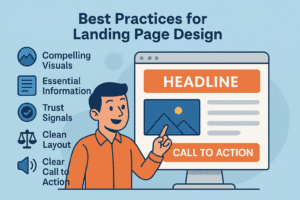
How to Design a Landing Page That Converts
User Experience and Conversion Flow
Guide users with a clear structure:
Headline
Benefits/Features
Social proof (testimonials, reviews)
Call-to-action
Call-to-Action Placement
Your CTA button must be visible without scrolling. Use action words like “Get Started” or “Claim Your Offer.”
Common Mistakes to Avoid in Landing Page SEO
Using a new domain for each product.
Overloading with images and videos.
Ignoring mobile compatibility.
Keyword stuffing.
Forgetting social sharing buttons.
Comparison Table: Landing Page vs Squeeze Page
| Feature | Landing Page | Squeeze Page |
|---|---|---|
| SEO Value | High | Very Low |
| Traffic Source | Organic + Paid | Mostly Paid |
| Content Quality | Informative | Minimal |
| User Experience | Designed for engagement | Focused on form submission |
| Long-term Value | Sustainable | Short-lived |
Additional Factors to Boost Landing Page Performance
The Importance of Loading Speed
Page speed is a decisive factor for both user satisfaction and search engine ranking. Every extra second of delay can cost you potential customers. Optimizing server performance, compressing files, and using a Content Delivery Network (CDN) are effective ways to ensure faster browsing.
Accessibility Standards
Modern websites should be accessible to everyone, including people with disabilities. Adding alternative text (alt text) to images, ensuring proper color contrast, and enabling easy navigation via keyboard shortcuts make the page more inclusive and professional.
Customer Testimonials and Social Proof
Highlighting authentic reviews or testimonials from previous clients builds trust instantly. This technique works as a powerful persuasion tool by showcasing real-life results instead of promotional claims.
Integration with Analytics Tools
Connecting your page to performance monitoring platforms such as Google Analytics or Google Search Console provides valuable insights. You can track user behavior, entry keywords, and conversion rates to refine your strategy.
A/B Testing for Better Conversions
Instead of relying on a single version of your page, create two variations and test them with real users. This approach helps you understand which design, call-to-action button, or color scheme performs better, allowing for data-driven decisions.
Security and Data Protection
If your page collects user data, SSL encryption is non-negotiable. The padlock symbol next to your URL reassures visitors that their information is safe, improving credibility and reducing bounce rates.
Trust-Building Visual Elements
Adding recognizable partner logos, secure payment badges, or official certifications increases confidence. Visitors are more likely to engage when they see clear signs of reliability and professionalism.
Advanced Elements to Strengthen Page Effectiveness
Behavioral Triggers
Modern pages can adapt based on visitor actions. For example, showing a pop-up discount when a user is about to leave, or offering a free resource after they scroll halfway down, increases engagement and reduces exit rates.
Heatmap Tracking
Using heatmap tools like Hotjar or Crazy Egg helps identify where users click the most, how far they scroll, and which elements they ignore. This data is vital to adjust the design and improve the interaction.
Personalization Through Dynamic Content
Pages that adapt based on location, device, or browsing history create a more relevant experience. For example, displaying different offers for mobile visitors compared to desktop users can boost conversions.
Micro-Interactions
Small interactive elements such as button hover effects, animated progress bars, or subtle transitions make the browsing experience more engaging without overwhelming the user.
Voice Search Optimization
With the rise of smart assistants like Alexa and Google Assistant, more users are searching via voice. Structuring content in a conversational tone and including question-based headings makes the page more likely to appear in voice results.
Structured Data Markup
Implementing schema markup helps search engines better understand your content. This can lead to rich snippets, which improve visibility in search results and increase click-through rates.
Retargeting Integration
Adding tracking pixels allows you to re-engage visitors through ads after they leave. Retargeting campaigns are especially effective for users who showed interest but didn’t convert.
Gamification Elements
Incorporating features like spin-to-win wheels, progress trackers, or point-based incentives can make the experience more fun and encourage users to take action.
Future Trends in Landing Page Optimization
Artificial Intelligence and Smart Personalization
AI-powered tools are transforming how businesses design and optimize digital experiences. Future pages will be able to automatically adjust text, visuals, and offers depending on each visitor’s behavior, demographics, and even browsing history. This level of personalization can dramatically increase relevance and conversion rates.
Automation and Predictive Analytics
Instead of manually testing design variations, predictive analytics will use machine learning to forecast which page version will perform best. Automated optimization will save time and reduce the trial-and-error process that marketers often face today.
Voice-First Experiences
As smart speakers and voice assistants become part of daily life, more users will arrive through spoken queries. Pages will need to adapt with conversational content, simplified structures, and voice-friendly navigation to remain competitive.
Immersive Technologies (AR & VR)
Augmented reality and virtual reality will add new layers of interactivity. Imagine a page where a user can virtually “try” a product before purchase or explore a 3D version of a service — this could redefine engagement standards.
Hyper-Fast Performance with 5G
With the global rollout of 5G networks, speed expectations will rise. Even small delays will seem unacceptable. Future-ready pages will need ultra-light frameworks, instant-loading features, and adaptive media delivery to meet user demands.
Privacy-First Design
Growing concerns over data collection will push businesses to be more transparent. Pages of the future will likely emphasize clear consent mechanisms, privacy notices, and options for users to control their own data.
Integration with Conversational Interfaces
Chatbots and conversational interfaces will play a bigger role. Visitors may interact with the page through a chatbot that guides them, answers FAQs instantly, and pushes them closer to making a decision.
FAQs about Landing Pages and SEO
Q1: What is the main difference between a Landing Page and a Squeeze Page?
A Landing Page is SEO-friendly and content-driven, while a Squeeze Page only collects quick leads through paid ads.
Q2: Can a Landing Page rank for multiple keywords?
Yes, if optimized properly, it can rank for several related keywords.
Q3: Should I use a subdomain for my Landing Page?
Yes, hosting it on a subdomain of your main site improves credibility and SEO value.
Q4: Do images harm SEO for landing pages?
Not if optimized. Keep them light and compressed to improve loading speed.
Q5: How important are social buttons on a Landing Page?
They’re essential for driving traffic from platforms like Facebook and LinkedIn.
Conclusion
A Landing Page isn’t just a digital flyer; it’s a powerful SEO asset. By understanding the difference between landing pages and focusing on design simplicity, integrating social buttons, and using strong titles and keywords, you can create a page that ranks higher and converts better. The key is balance: make it appealing for users while optimized for search engines.