Choosing Ecommerce Platform in 2024: Complete Small Business Guide
When it comes to choosing ecommerce platform in 2024, small business owners face a challenging decision. With countless tools and services promising growth, ease, and scalability, the real question is — how do you know which one is truly right for your business? This choice is more than just picking a tool; it’s the foundation for your online presence and long-term profitability.
Imagine investing months of work and resources into a platform, only to realize it doesn’t align with your budget, your audience, or your growth ambitions. The wrong choice can lead to frustrating limitations, higher costs, and lost opportunities. The right choice, on the other hand, empowers you to sell more, manage efficiently, and scale with confidence.
In this article, we’ll explore a structured decision framework designed for small business owners in the US and UK markets. We’ll break down your options, compare leading platforms like Shopify vs WooCommerce vs BigCommerce, analyze costs, scalability, and beginner-friendliness, and help you identify the platform that aligns perfectly with your goals.


Understanding the E-commerce Landscape in 2024
E-commerce has evolved far beyond the simple “online store” concept. It now encompasses multi-channel sales, advanced automation, personalized customer experiences, and deep integration with marketing tools,
To make the right choice, it’s vital to understand:
Your target audience and their buying habits
Your product type (digital, physical, or hybrid)
Your operational capabilities (team size, tech skills)
Your short- and long-term business goals
For a deeper understanding of the different e-commerce types and their characteristics, you can refer to this comprehensive guide.
The Core Decision Framework for Choosing Ecommerce Platform
Step 1 — Define Your Business Model
Before comparing platforms, be crystal clear about your business model. Are you B2C, B2B, or C2C?
B2C (Business-to-Consumer): Selling directly to end consumers. Platforms like Shopify excel here.
B2B (Business-to-Business): Selling to other businesses often requires custom pricing and bulk ordering features. BigCommerce offers robust solutions.
C2C (Consumer-to-Consumer): This involves individuals selling to each other, often through marketplaces.
Step 2 — List Your Non-Negotiable Features
This might include:
Payment gateway compatibility
Inventory management features
SEO customization
Mobile responsiveness
Integration with marketing tools
Step 3 — Compare the Big Three Platforms
| Feature | Shopify | WooCommerce | BigCommerce |
|---|---|---|---|
| Ease of Use | Excellent | Moderate (depends on WordPress skills) | Excellent |
| Cost | Monthly fee + transaction fees | Hosting + plugins cost | Monthly fee |
| Scalability | High | High (with right hosting) | High |
| Customization | Moderate | Very High | Moderate |
| Best For | Beginners & small to mid-size stores | WordPress users | Larger catalogs & B2B |
Shopify vs WooCommerce vs BigCommerce — Who Wins?
1. Shopify
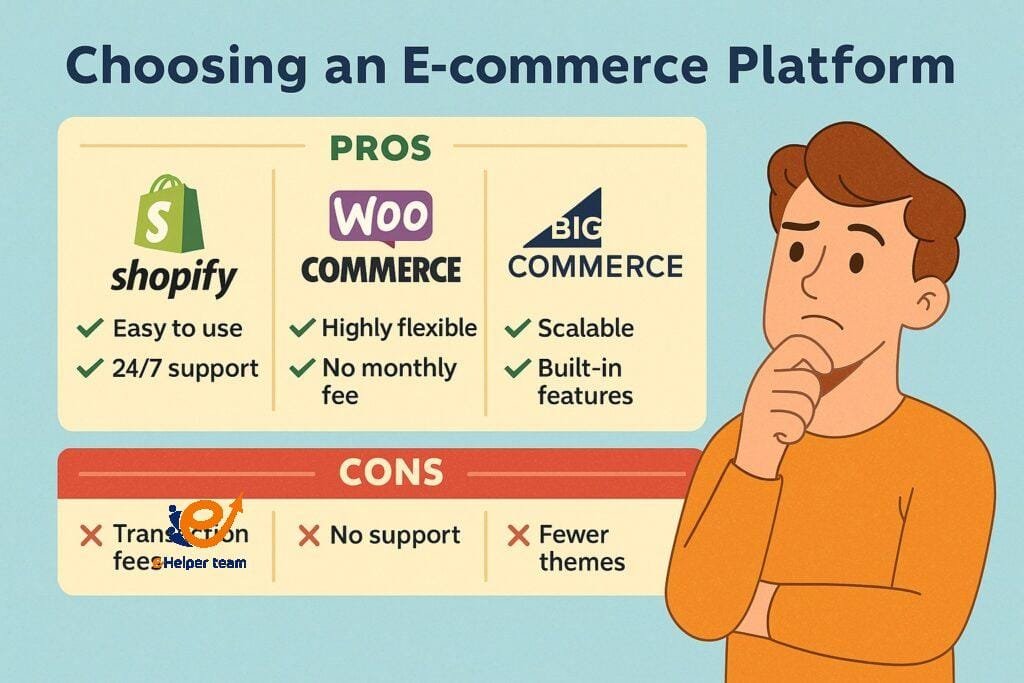
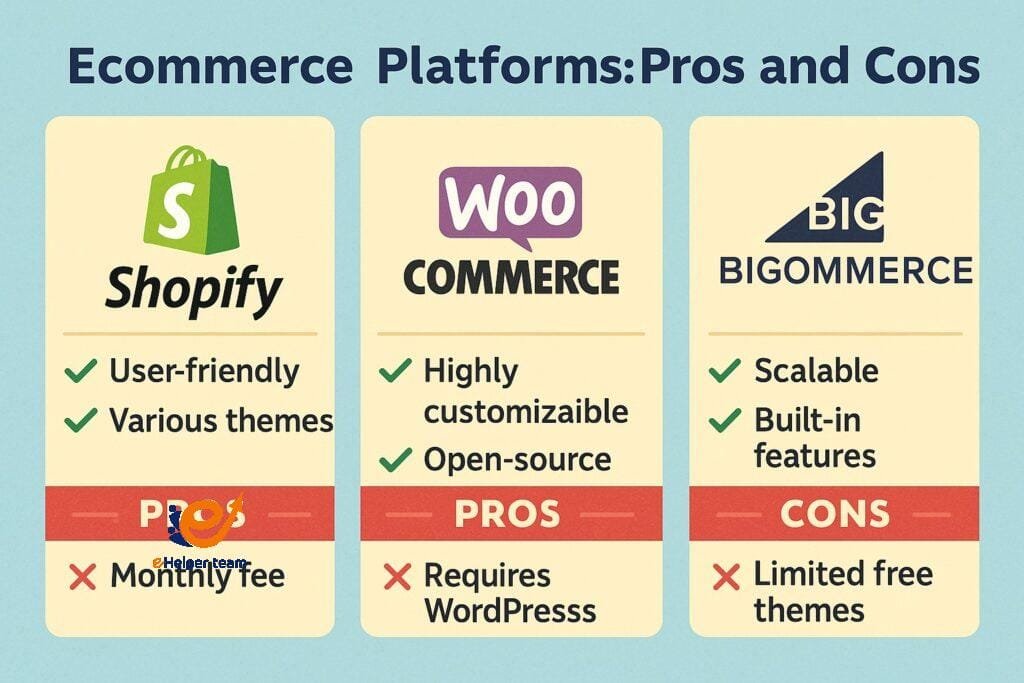
Shopify is often the go-to for beginners thanks to its intuitive interface, professional templates, and all-in-one package. However, it charges monthly fees and transaction costs, which can add up.
2.WooCommerce
WooCommerce is an open-source WordPress plugin offering complete customization. It’s ideal for those with technical know-how or access to a developer. While flexible, it requires hosting and can become complex with too many plugins.
3. BigCommerce
BigCommerce offers powerful built-in features for larger stores or those needing advanced B2B capabilities. It’s slightly less beginner-friendly than Shopify but can save money on third-party app costs.
Comparing Fees and Scalability
Choosing the wrong platform can mean paying more than you need for features you don’t use, or struggling to grow when your store outgrows the platform’s limits.
Shopify: Predictable monthly pricing, but third-party apps and transaction fees can push costs higher.
WooCommerce: Lower starting costs, but hosting and premium plugin fees can escalate.
BigCommerce: Competitive pricing for built-in features, but fewer budget-friendly options for micro-businesses.
Here’s a quick tip — start with your two-year growth forecast and calculate costs based on expected traffic and sales volume. This prevents unpleasant surprises.
Real-World Case Study
Consider a small UK-based home décor brand starting with 50 SKUs. They began with WooCommerce due to its low entry cost and WordPress integration. Within two years, sales tripled, but hosting couldn’t keep up, causing downtime during peak shopping seasons. They migrated to Shopify for stability, sacrificing some customization but gaining uptime reliability.
This example shows why scalability and performance should be top priorities from day one.
Best Platform for Beginners
If you’re launching your first online store, ease of use, support, and built-in features matter most.
Winner for beginners: Shopify — simple setup, excellent support, and plenty of templates.
Runner-up: BigCommerce — great features but slightly more complex setup.
For a deeper dive into consumer-to-consumer models, see this detailed resource.
Scaling Up — When to Switch Platforms
Switching platforms is disruptive but sometimes necessary. Signs it’s time to move:
Frequent downtime
High third-party costs
Difficulty adding new sales channels
Poor mobile performance
The Psychological Side of Choosing an Ecommerce Platform
When small business owners think about choosing ecommerce platform, they often focus on features and costs, but customer psychology is just as critical. The way your platform displays products, processes payments, and follows up with customers influences trust and repeat purchases.
Key psychological triggers to consider when selecting a platform:
Speed: Pages loading within 2–3 seconds increase trust.
Simplicity: A clutter-free checkout process boosts conversions.
Personalization: Platforms with AI product recommendations can improve sales by 15–20%.
Transparency: Clear return policies and visible contact details reduce cart abandonment.
Security and Data Protection — A Non-Negotiable Factor
Security is not optional in e-commerce; it’s a legal and brand trust requirement. A platform must:
Offer SSL certificates by default.
Comply with GDPR (for UK/EU customers) and CCPA (for US customers).
Provide robust fraud detection tools.
Enable secure payment integrations like Stripe, PayPal, and Apple Pay.
Platforms like Shopify and BigCommerce have these features built in, while WooCommerce requires manual setup. Neglecting this area can lead to costly data breaches and loss of customer trust.
Integrating Your Platform with Digital Marketing Strategies
Your e-commerce platform should work seamlessly with your marketing approach. Consider:
SEO optimization: Platforms like WooCommerce offer deep SEO flexibility through plugins.
Email marketing integration: Shopify integrates with Klaviyo and Mailchimp effortlessly.
Social media selling: BigCommerce supports direct Facebook, Instagram, and TikTok sales.
Analytics tools: Google Analytics, heatmaps, and in-dashboard insights help track performance.
For a detailed foundation on the types of e-commerce and their marketing implications, you can explore this resource .
Measuring Success — Key Performance Indicators (KPIs)
Once you’ve chosen your platform, measure its effectiveness using these KPIs:
Conversion rate: Percentage of visitors who make a purchase.
Average order value (AOV): Higher AOV indicates better upselling and cross-selling.
Customer lifetime value (CLV): Measures long-term profitability.
Cart abandonment rate: Should be below 60% for healthy stores.
Page load speed: Affects SEO and user experience.
Future-Proofing Your Choice — Post-2024 Trends
E-commerce technology is evolving rapidly. After 2024, expect to see:
Headless commerce for faster site speed and more design freedom.
Blockchain-based payments for enhanced security.
Voice commerce becoming standard in household shopping.
Hyper-personalized AI shopping assistants embedded into stores.
Platforms that adapt quickly to new technologies will provide a competitive edge.
Frequently Asked Questions
Q1: How do I choose between Shopify, WooCommerce, and BigCommerce?
A: Compare based on ease of use, cost, scalability, and your technical skills. Shopify is best for beginners, WooCommerce for customization, and BigCommerce for built-in advanced features.
Q2: What’s the most cost-effective platform for a small startup?
A: WooCommerce can be cheapest initially, but costs vary with hosting and plugins. Shopify offers predictable pricing but may be higher overall.
Q3: Can I migrate from one e-commerce platform to another later?
A: Yes, but migration can be complex. Plan carefully to avoid downtime and data loss.
Q4: Which platform is best for selling internationally?
A: BigCommerce and Shopify both offer strong multi-currency and localization features.
Q5: Do I need coding skills to run an e-commerce store?
A: Not necessarily. Shopify and BigCommerce don’t require coding, but WooCommerce benefits from some technical knowledge.
Conclusion
Choosing ecommerce platform wisely can save you years of frustration and set your business on a path to sustainable growth. Your choice should balance immediate needs with long-term goals, factoring in cost, scalability, and your comfort level with technology.
Before you make the leap, explore all your options, run cost simulations, and consider both your current needs and where you want to be in two to three years. For more insights on B2C strategies, check this essential guide.