Ecommerce CRO Checklist: 25 Smart Tweaks to Boost Sales
The ecommerce cro checklist is the missing piece for every store owner asking the same question: why do thousands of visitors browse my products but only a handful actually buy? This is not about luck—it’s about understanding how people shop online and what convinces them to take action.
Think about your own store for a moment. Do your product pages highlight benefits or just list features? Is your checkout smooth or cluttered with unnecessary steps? Are you offering enough trust signals to reassure hesitant buyers? These small details could be costing you hundreds or even thousands in lost revenue every single month.
The truth is simple: driving traffic without conversion optimization is like pouring water into a leaking bucket. By learning how to increase conversion rate through proven methods like optimizing product pages, checkout process optimization, and adding strong trust signals, you can transform your ecommerce store into a reliable sales machine. In this article, you’ll discover 25 powerful tweaks—each one tested and proven—that will help you capture more customers and maximize your revenue. Let’s begin your journey to higher sales.

What is Ecommerce CRO and Why Does It Matter?
Understanding CRO in Online Stores
CRO, or Conversion Rate Optimization, is the practice of turning more of your visitors into paying customers. It focuses on improving every interaction, from browsing products to completing checkout. A good CRO strategy means more sales from the same traffic—without increasing ad spend.
Why Most Stores Struggle with Conversions
The biggest issue for most ecommerce sites isn’t traffic—it’s leaks in the funnel. Customers abandon carts due to confusing checkout processes, poor mobile design, or lack of reassurance. Addressing these weaknesses is the key to sustainable growth.
The Ultimate Ecommerce CRO Checklist
Optimizing Product Pages for Conversions
Your product page is your virtual salesperson. To maximize conversions:
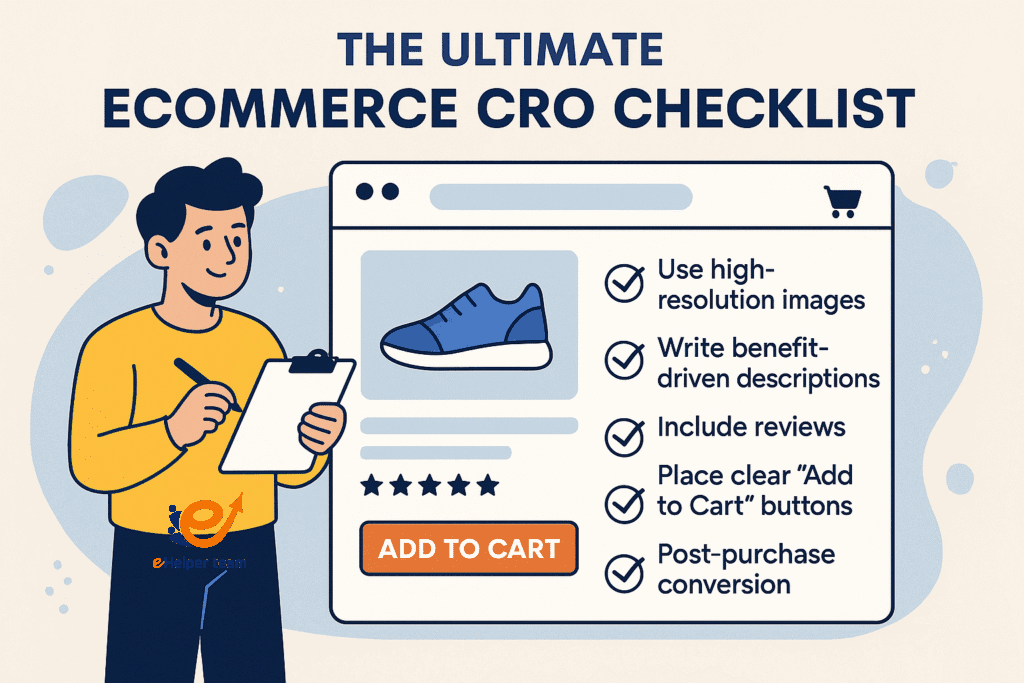
Use high-resolution images with multiple angles
Write benefit-driven descriptions, not just technical specs
Include reviews and user-generated content
Place clear, visible “Add to Cart” buttons
Helpful resource: 10 Best Free Shopify Apps for New Stores to Boost Sales and Growth
Checkout Process Optimization
Simplify checkout steps into one or two pages
Offer guest checkout to reduce friction
Provide multiple payment options
Display delivery and shipping costs upfront
Adding Powerful Trust Signals
Customers buy when they feel safe. Add:
Money-back guarantees
Secure payment badges
Clear return and refund policies
Live chat or customer support availability
How to Increase Conversion Rate with Data and Testing
Tracking User Behavior with Analytics
Data is the foundation of CRO. Setting up Google Analytics 4 (GA4) helps track behavior and highlight problem areas. Learn how with this step-by-step GA4 setup guide.
Running A/B Tests for Maximum Impact
Test product titles, images, button colors, and checkout layouts to see which version converts better. Even small adjustments can deliver big results.
Choosing the Right Platform for Better CRO
The platform you choose affects how easily you can implement CRO strategies. Some platforms are more flexible than others. For a full breakdown, see Choosing Ecommerce Platform in 2024.
If you’re torn between two of the most popular options, this Shopify vs WooCommerce comparison highlights strengths, weaknesses, and which fits your needs best.
Case Study: Before and After CRO Implementation
To illustrate the impact of CRO, let’s compare two versions of a fictional online furniture store.
| Element | Before CRO | After CRO |
|---|---|---|
| Product Pages | Basic images, short descriptions | High-resolution images, benefit-driven copy, customer reviews |
| Checkout | 5 steps, no guest checkout | 2 steps, guest checkout enabled, multiple payment options |
| Trust Signals | None visible | SSL badge, money-back guarantee, return policy shown |
| Results | 1.5% conversion rate | 3.2% conversion rate |
This simple comparison shows how optimizing product pages and focusing on checkout process optimization doubled conversions without spending extra on ads.
The Role of Trust Signals in Long-Term Growth
Trust signals are not just about the first sale—they build long-term credibility. A strong return policy, verified customer reviews, and social proof through influencer endorsements establish reliability. Over time, these elements encourage repeat purchases, which are more profitable than acquiring new customers. By consistently displaying trust signals, you strengthen customer loyalty while improving conversions.
Using AI and Automation in CRO
Artificial Intelligence (AI) is revolutionizing ecommerce. AI-driven product recommendations, dynamic pricing, and predictive analytics allow stores to anticipate customer needs. For instance, if analytics detect a trend where customers often buy accessories with a main product, AI can automatically suggest bundles. Automation also enables real-time optimizing product pages by testing layouts and content at scale, something manual A/B testing cannot achieve as quickly.
AR, VR, and Conversational Commerce
Looking ahead, conversion optimization will be shaped by immersive technologies. Augmented Reality (AR) lets shoppers “try on” clothes or visualize furniture in their homes before buying. Virtual Reality (VR) can create full shopping experiences from home. Conversational commerce, powered by AI chatbots, is another area that simplifies decision-making by guiding users to the right products instantly.
For store owners, adopting these innovations early ensures you stay ahead of competitors while delivering superior shopping experiences.
Step-by-Step Action Plan
Here’s a quick action plan to start implementing the ecommerce cro checklist today:
Audit your product pages → Update descriptions, add reviews, and use high-quality visuals.
Streamline the checkout process → Reduce steps and enable guest checkout.
Add visible trust signals → Guarantees, return policies, and security badges.
Test personalization features → Use customer data for recommendations.
Experiment with AI tools → Automate testing and product suggestions.
Each step may seem small, but together they create a powerful engine for conversions and long-term growth.
Advanced Personalization Tactics
Show different homepages for new vs. returning visitors
Use customer purchase history to recommend complementary items
Display location-based offers (e.g., “Free shipping to London today”)
Psychological Triggers That Drive Conversions
Use anchoring pricing: show a higher “original price” next to the discounted one
Highlight “best seller” or “most popular” labels to guide choices
Apply social nudges: “125 people bought this in the last 24 hours”
Mobile CRO Enhancements
Use sticky “Add to Cart” buttons that remain visible while scrolling
Simplify product filters for one-hand mobile use
Optimize page speed specifically for 4G/5G connections
Trust & Transparency Beyond Basics
Add customer service response time (e.g., “Avg. reply in under 5 minutes”)
Show verified badges for reviews (e.g., “Verified Buyer”)
Display real-time stock levels for transparency
Retention-Focused CRO
Create a “subscribe & save” option for consumable products
Offer instant discounts for creating an account during checkout
Build customer tiers (Silver, Gold, Platinum) to reward loyalty
AI-Driven CRO
Use AI to predict customer intent and trigger tailored pop-ups
Automate product bundles based on previous shopping patterns
Implement chatbots that upsell or cross-sell during conversations
Post-Purchase Conversion Boosters
Add referral programs: “Give $10, Get $10” for inviting friends.
Include unboxing instructions or tips in confirmation emails.
Send time-sensitive re-order reminders (e.g., “Running low? Refill now”).

FAQs
Q1: What’s the easiest way to improve conversions quickly?
Simplify the checkout process—fewer steps, fewer drop-offs.
Q2: How often should I update my CRO strategy?
At least quarterly, since user behavior and ecommerce trends change often.
Q3: Do trust signals really make a difference?
Yes, they reduce uncertainty and increase purchase confidence significantly.
Q4: Should small stores focus on CRO or traffic first?
CRO first—it ensures every visitor is maximized before scaling traffic.
Final Thoughts
CRO is a continuous process, not a one-time project. By following this ecommerce cro checklist and making small, consistent improvements, you’ll steadily boost your sales without needing extra traffic.
READ ALSO: Set Up GA4 for Ecommerce – Step-by-Step Beginner’s Guide