The difference between digital currencies VS.
In today’s rapidly evolving economy, the concept of money has expanded far beyond physical notes and coins. Many people confuse digital currencies with cryptocurrencies, often using the two terms interchangeably. But while they share similarities, their foundations, control systems, and uses are quite different.
At E-Helper Team, we know this confusion is common, so we’ve prepared a comprehensive guide to explain the real differences between digital currencies and cryptocurrencies. To begin, you can also explore our dedicated article here: The difference between digital currencies VS. cryptocurrencies.

What Are Digital Currencies?
Digital currencies are forms of money that exist only in electronic form. They can be centralized (like Central Bank Digital Currencies, or CBDCs) or decentralized in nature. Unlike physical money, they have no paper or coin form—but they function in similar ways.


Key Features
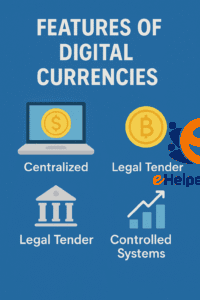
Central Authority Control – Many digital currencies are issued and regulated by governments or financial institutions.
No Physical Existence – They are stored in digital wallets or bank accounts.
Borderless Transactions – They can be sent across the globe without traditional restrictions.
Usability – They can be used for online shopping, utility payments, and service subscriptions.
The rise of CBDCs highlights the importance of digital currencies. Countries like China, Sweden, and the EU are actively developing their own central bank digital money. Unlike cryptocurrencies, these are backed by the state, making them legal tender with strong regulation.
In short, digital currencies modernize traditional money for a digital-first world, but they don’t fundamentally change the role of central authorities.
What Are Cryptocurrencies?
Cryptocurrencies are a type of digital currency, but with one crucial difference: they are decentralized and secured by cryptography. Instead of being controlled by governments, they operate on blockchain networks.
Defining Features
Blockchain Technology: Every transaction is validated and stored in a public ledger.
Decentralized Governance: No bank or central institution manages it.
Security Through Encryption: Strong mathematical algorithms secure the network.
Volatility: Their values can change dramatically within hours.
A major process in many cryptocurrencies is mining—where users validate transactions and keep the network secure. Want to learn more? Read our practical guide on Get started with MinerGate.com, a popular mining pool platform.
Cryptocurrencies like Bitcoin, Ethereum, and others symbolize financial freedom, but they also come with challenges such as regulation gaps, extreme volatility, and scalability issues.
Digital Currencies vs Cryptocurrencies: Key Differences
Though both live in the digital space, they serve very different purposes:
| Feature | Digital Currencies | Cryptocurrencies |
|---|---|---|
| Issuer | Governments, central banks | Decentralized blockchain |
| Legal Status | Legal tender | Varies by country |
| Control | Centralized | Decentralized |
| Stability | Stable, tied to fiat | Highly volatile |
| Transparency | Controlled systems | Public blockchain |
| Use Case | Daily payments, state policy | DeFi, NFTs, global peer-to-peer |
Digital currencies are essentially the digital version of existing fiat systems, while cryptocurrencies represent a complete rethinking of how money can work.
Regulation, Security, and Global Adoption
Regulation
Digital currencies, especially CBDCs, are tightly regulated and often tied to national monetary policies.
Cryptocurrencies, however, exist in a regulatory gray zone. Some countries ban them, others regulate lightly, while a few fully embrace them.
Security
Centralized systems (digital currencies) rely on government and banking infrastructure, which may be vulnerable to targeted attacks.
Cryptocurrencies rely on encryption and decentralization, reducing single points of failure—but making individuals responsible for their own wallet security.
Global Adoption
By 2025, more than 130 countries are testing or considering CBDCs. Meanwhile, cryptocurrencies like Bitcoin and Ethereum remain highly popular, used both as investment assets and tools for financial innovation.
Use Cases in Daily Life and Business
Digital currencies are expected to be integrated seamlessly into everyday transactions. They could soon replace cash in:
Utility payments
Public services
Retail and e-commerce
Government subsidies
Cryptocurrencies, however, are reshaping entire industries:
DeFi (Decentralized Finance): Borrowing, lending, and trading without banks.
NFTs and Gaming: Digital ownership of unique assets.
Cross-Border Transfers: Sending money across countries quickly and cheaply.
While digital currencies simplify everyday payments, cryptocurrencies fuel innovation and empower individuals with financial autonomy.
Future Outlook: Coexistence Ahead
The future will likely see both systems coexisting. Digital currencies will handle regulated, everyday use cases, while cryptocurrencies will remain a hub for innovation.
Stablecoins—cryptocurrencies pegged to fiat currencies—may serve as a bridge between the two worlds. Regulations will continue to evolve, shaping how both systems develop.
For more insights into where the crypto market is headed, check out our article: Bitcoin Future and Its Price Prediction 2025.
Additional Section 1: How Blockchain Powers Cryptocurrencies
At the heart of cryptocurrencies lies blockchain technology. A blockchain is a decentralized digital ledger that records all transactions across a network of computers. Unlike traditional databases, no single authority controls it. Instead, transactions are verified collectively, creating a system that is transparent, secure, and resistant to tampering.
Each transaction is grouped into a block, which is linked to the previous block, forming a chain. This is why data on blockchains cannot be easily altered without changing all subsequent blocks—something practically impossible given the network size.
Why This Matters:
Trustless System: Users do not need to trust each other or an intermediary; they trust the code and cryptography.
Immutability: Once added, data cannot be changed, ensuring reliable transaction history.
Security: Attacks are difficult because altering the chain would require immense computing power.
This is what differentiates cryptocurrencies from other digital currencies. While digital currencies can exist without blockchain, the blockchain makes cryptocurrencies decentralized, secure, and revolutionary.
Additional Section 2: Economic Impact of Digital Currencies and Cryptocurrencies
The rise of digital currencies and cryptocurrencies is reshaping economies worldwide.
For Governments
CBDCs give central banks new tools for monetary policy. For example, they can issue stimulus directly to citizens’ wallets.
However, they may also reduce the role of commercial banks if people prefer holding central bank digital wallets.
For Businesses
Digital currencies reduce transaction costs and increase speed, particularly for global trade.
Cryptocurrencies open new revenue models, like accepting Bitcoin payments or creating NFT-based products.
For Individuals
Digital currencies make financial services more accessible, especially in unbanked regions.
Cryptocurrencies provide alternatives in countries facing inflation or unstable banking systems.
The dual growth of digital currencies and cryptocurrencies shows how money is no longer just a tool of exchange—it’s a driver of innovation, policy, and empowerment.
Additional Section 3: Challenges and Risks Ahead
While both systems hold promise, they also face major challenges.
Volatility: Cryptocurrencies are highly volatile, limiting their use as stable money.
Regulation: Governments are still figuring out how to regulate cryptocurrencies without stifling innovation.
Privacy Concerns: CBDCs may allow governments to monitor every transaction, raising ethical issues.
Cybersecurity: Both systems are targets for hackers, though in different ways. Wallet hacks affect crypto, while CBDCs could face attacks on central systems.
Public Trust: Widespread adoption depends on whether people trust these digital forms of money.
Addressing these issues will determine how successfully both digital currencies and cryptocurrencies can integrate into daily financial life.
Frequently Asked Questions (FAQs)
1. What is the main difference between digital currencies and virtual currencies?
Digital currencies are a broad category that includes official state-backed money like CBDCs, while virtual currencies are often platform-specific (such as tokens in online games) and may not hold value outside that ecosystem.
2. Are Central Bank Digital Currencies the same as electronic bank transfers?
No. Bank transfers move traditional fiat money electronically, while CBDCs represent a new, purely digital form of state-issued money that exists independently of cash.
3. Can digital currencies replace cash completely?
It is possible, but unlikely in the near future. Many governments are testing digital alternatives, but cash still plays a role for privacy, inclusivity, and resilience during technical failures.
4. How secure are blockchain-based assets compared to traditional digital money?
Blockchain-based assets are secured through cryptographic algorithms and decentralized networks, making them resistant to tampering. However, users remain vulnerable to scams, phishing, or losing private keys.
5. Why do some countries ban or restrict digital assets?
Governments may restrict certain digital assets due to concerns about money laundering, terrorism financing, tax evasion, or potential disruption to national financial stability.
6. What industries are most affected by digital forms of money?
Banking, retail, online commerce, and gaming are heavily impacted. In addition, new sectors like decentralized finance, tokenized assets, and digital art markets are emerging thanks to these innovations.
Conclusion
To sum up:
Digital currencies modernize the current system under government oversight.
Cryptocurrencies introduce decentralization, innovation, and autonomy.
Both will play crucial roles in the coming years, shaping how individuals, businesses, and governments think about money. Understanding the differences between digital currencies and cryptocurrencies will help you stay ahead in this new financial era.