Top 5 Competitive SEO Factors in 2025 That Will Redefine Your Google Rankings
In today’s digital-first world, businesses are in a constant battle to secure visibility on search engines. With millions of websites competing for user attention, mastering Competitive SEO Factors is no longer optional—it’s essential. These factors define whether your website ranks on the first page or gets buried beneath competitors.
As Google continues to refine its algorithms, SEO has become more sophisticated. It’s not just about keywords anymore—it’s about authority, relevance, and user experience. To outperform competitors in 2025, marketers must embrace the five most Competitive SEO Factors that consistently determine ranking success. For a deeper understanding of the fundamentals, check out this detailed guide on SEO Basics for Beginners in 2025.
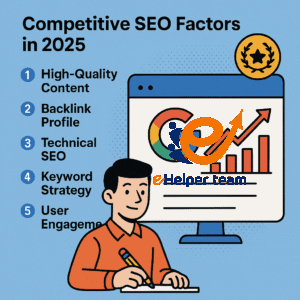
Factor 1: High-Quality Content as the Core of SEO
Content is the backbone of every successful SEO strategy. Search engines prioritize web pages that deliver genuine value to readers. Google’s algorithms are increasingly designed to detect shallow, duplicated, or keyword-stuffed content and penalize it.


Understanding Google’s EEAT Framework
The EEAT principle—Expertise, Experience, Authoritativeness, and Trustworthiness—sets the gold standard for online content. In practice, this means:
Expertise: Content must be written or reviewed by knowledgeable professionals.
Experience: Firsthand insights make content more authentic.
Authoritativeness: Citations, backlinks, and social proof validate authority.
Trustworthiness: Clear sources, secure domains (HTTPS), and accuracy build trust.
Websites that align with EEAT are better positioned to rank against their competitors.
How Content Depth and Relevance Influence Ranking
Modern SEO goes beyond surface-level content. Long-form, in-depth guides that address multiple aspects of a topic rank better. By incorporating FAQs, examples, statistics, and multimedia, you create a richer user experience. For instance, improving blog readability and structure can dramatically increase user retention and engagement.
In 2025, Competitive SEO Factors demand that content creators prioritize quality over quantity. A single comprehensive guide will likely outperform dozens of short, thin articles.
Factor 2: Backlink Profile and Authority Signals
Backlinks remain one of the strongest ranking signals. They act as “votes of confidence” from other websites, signaling to search engines that your content is credible and valuable.
The Role of Domain Authority and Trust Flow
Search engines use link-based metrics to evaluate site credibility. A website with high domain authority often has strong backlink networks, which increase its ranking potential. Trust Flow, another metric, measures link quality rather than quantity. Links from government sites, universities, or well-established publications carry significant weight compared to random blog mentions.
How to Earn Competitive Backlinks in 2025
Gone are the days of buying links or using link farms. Google penalizes manipulative strategies harshly. Instead, the most effective approaches include:
Guest Posting on High-Authority Sites
Creating Data-Driven Reports and Case Studies
Leveraging Digital PR for Media Coverage
Building Shareable Visuals (infographics, charts, videos)
For further insights, read this guide on backlinks advantages and disadvantages, which explains how different types of backlinks affect rankings.
Factor 3: Technical SEO and Site Performance
Even the best content won’t rank if your website isn’t technically optimized. Technical SEO ensures that search engines can efficiently crawl, index, and rank your site.
Core Web Vitals and User Experience Metrics
Google’s Core Web Vitals measure site speed, responsiveness, and visual stability. A site that loads slowly or shifts layout unexpectedly frustrates users, leading to higher bounce rates. Optimizing for fast load times, responsive design, and smooth navigation directly impacts rankings.
Mobile Optimization and Indexing Trends
With mobile-first indexing, Google now evaluates websites based on their mobile version. This shift makes responsive design a necessity rather than an option. Sites that fail to deliver seamless mobile experiences risk losing organic visibility.
You can strengthen your technical foundation by leveraging powerful Google services for webmasters, ensuring your website stays aligned with algorithm updates.
Among all Competitive SEO Factors, technical SEO is often overlooked, but it provides the foundation upon which every other ranking strategy stands.
Factor 4: Keyword Strategy and Search Intent Alignment
Keywords remain the bridge between users and websites. However, the way we approach them has evolved drastically.
Long-Tail vs. Competitive Keywords
High-volume competitive keywords are tough to rank for, especially for new websites. Long-tail keywords, though less searched, attract highly targeted traffic. For example, “best fitness tips for beginners” is easier to rank than “fitness.”
Semantic SEO and Natural Language Processing
Search engines increasingly rely on AI and NLP to interpret context. This means stuffing the exact keyword into content is no longer enough. Instead, Google rewards content that covers related terms, synonyms, and topic clusters.
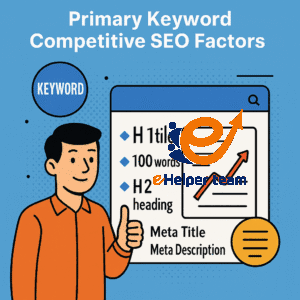
To optimize effectively, you should also master meta tag optimization for SEO, which directly influences how your keywords align with user queries.
The ability to align keyword usage with search intent remains a defining Competitive SEO Factor. Websites that predict and meet search intent gain a sustainable advantage.
Factor 5: User Engagement and Behavioral Signals
Search engines monitor how users interact with your site as a signal of relevance and value.
Click-Through Rates and Dwell Time
A high click-through rate (CTR) indicates compelling meta titles and descriptions. Meanwhile, longer dwell times suggest users find content engaging and stay longer on the page. Both metrics influence rankings.
The Growing Importance of Interaction Metrics
Beyond clicks and time spent, Google considers bounce rates, scroll depth, and repeat visits. Interactive elements like videos, quizzes, and comment sections improve engagement.
For a step-by-step breakdown, check this practical on-page SEO checklist to make your content more engaging and interactive.
In 2025, user engagement will stand out as one of the most competitive SEO battlegrounds. Businesses that deliver outstanding user experiences will dominate search results.
FAQs: Understanding Competitive SEO Factors in 2025
Q1: What are Competitive SEO Factors?
They are the most important ranking signals search engines use to determine which websites appear at the top of search results.
Q2: Which Competitive SEO Factor is most important?
Content quality remains the top factor, but it must work in combination with backlinks, technical SEO, and engagement.
Q3: How do backlinks affect SEO competitiveness?
Backlinks signal authority and trust, helping websites build credibility and rank higher.
Q4: Why is technical SEO often underestimated?
Because it’s less visible than content, yet it ensures search engines can properly index your site.
Q5: How often should SEO strategies be updated?
At least quarterly, since Google updates its algorithms frequently.
Q6: Can small businesses compete with big brands in SEO?
Yes—by focusing on long-tail keywords, niche content, and local SEO.
Also: 20 Best Guest Posting Sites to Submit Guest Posts
Conclusion: How to Stay Ahead with Competitive SEO Factors
SEO is a constantly evolving discipline. In 2025, businesses that master Competitive SEO Factors—from content excellence and backlink authority to technical precision, keyword strategy, and user engagement—will secure sustainable growth.
To stay competitive, brands must embrace innovation, monitor algorithm changes, and consistently prioritize user value. By doing so, they won’t just rank higher; they’ll build digital trust and long-term online authority.
For a broader perspective, explore this article on the importance of SEO optimization in the digital era.